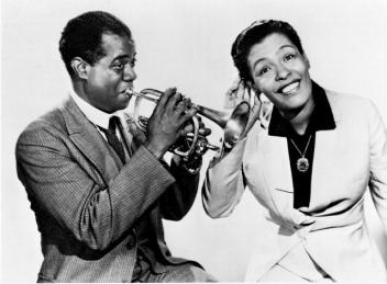
Showing posts with label Billie Holiday. Show all posts

Sunday, October 4, 2009

Billie Sunday, no.5, With a little help from my friends


So my friend and workmate Ed Moloy went down to Austin, Texas for one of those out of control librarian/archivist conferences, found his way to a Kat Edmonson concert, and promptly fell head over heels for the singer. It's not hard to hear why.

Kat Edmonson - Summertime [buy]

SalGal texted me today from the Hardly Strictly Bluegrass fest in San Francisco. Tons of great artists, including Mavis Staples, Todd Snider, and Booker T jamming with the Drive-By Truckers.


Booker T & the MGs version of "Summertime" has a somberness which captures something essential about the song.

Booker T. & The MGs [buy]


But then there's Billie and the gang putting another spin on the whole affair. Bunny Berigan's muted trumpet practically tells the whole story, but then Billie steps in as only Lady can to complete the tale.

Billie Holiday - Summertime [buy]

Sunday, August 23, 2009

Billie Sunday, no.4 - Karen Dalton


Image from Light in the Attic Records

In Volume 1 of Chronicles, Dylan reminisced that Karen Dalton, with her Billie Holiday voice and Jimmy Reed guitar skills, was his favorite singer at Cafe Wha?. And it’s not hard to hear the comparison to Billie.


Upon first encountering Dalton’s singing, my reaction, besides astonishment at the broken-hearted beauty of her melancholy blues, was to wonder “where is she from?” For while Dalton made her name in the 60s New York folk scene, she hails from Oklahoma and sounds undeniably Country. And though I’ve yet to hear anyone claim Lady Day sounded like a country singer -- her perfect diction isn’t exactly what most country singers are known for -- the title to Dalton’s second studio album, In My Own Time, nicely illustrates one of the main parallels between the two singers: a world-weary Southern languorousness which refuses to hurry-up for anyone.

Karen Dalton - In My Own Dream [buy]

Though I’d say this isn’t what Bob had in mind, another prime comparison arises from the limited vocal range of both singers -- neither possesses a big voice. Early in her career, this “lack” to Billie’s voice caused some people to think she wasn’t much of a singer. With Dalton, I have to think the frailty to her voice is a big reason for the “acquired taste” backhanded compliment paid to her. But both singers turn this lack into intimate presence. Before her recording career took-off, Billie played the Harlem clubs for tips, walking from table to table, singing low to individual tables and amazing the patrons with her ability to improvise endlessly. (Microphones weren’t permitted anyway -- amplified sound might drift into the streets, calling unwanted attention to an illegal club.) Known for her extreme reluctance to perform, in studio or live settings, Dalton’s voice effortlessly signifies anti-modern country blues authenticity.

Karen Dalton - Blues On My Ceiling [buy]

Even on her second, more heavily produced album, In My Own Time, there are moments, as during the end of “Something On Your Mind,” when Dalton seems to sing to herself, as though she is so caught up in the song that the performance is secondary -- which only makes the performance that much more powerful. (Easy to see comparisons to the eternally shy and performance-averse Nick Drake.)

Karen Dalton - Something On Your Mind [buy]

Obviously, Dalton never attained Holiday’s popularity, but she may finally be getting some of the attention she deserves. It never hurts to have Bob sing your praises in the first volume of his autobiography. So if you haven’t found your way to her music yet, both of Dalton’s two studio albums are well worth your time. She's an absolutely singular artist.

Sunday, August 2, 2009

Billie Sunday, no.3 - Bessie & Louis


Today’s Billie Sunday is devoted to Bessie Smith and Louis Armstrong -- the two main musical influences on Lady Day. In her own words:

I think I copied my style from Louis Armstrong. Because I used to like the big volume and the big sound that Bessie Smith got when she sang. But when I was quite young, I heard a record Louis Armstrong made called the “West End Blues.” And he doesn’t say any words, and I thought, this is wonderful! And I like the feeling he got from it. So I liked the feeling that Louis got and I wanted the big volume that Bessie Smith got. But I found that it didn’t work with me, because I didn’t have a big voice. So anyway between the two of them I sorta got Billie Holiday.

Louis Armstrong - West End Blues

What I find interesting about Billie’s statement is how it places the influence of Bessie Smith. For while Lady Day claims that it was “between the two of them” that she got her way of singing, she only states that (because of her smaller voice) she couldn’t be Bessie. Whereas Louis’ “singing” with his horn was a way of approaching a song which she wanted to emulate and felt as though she could. And many musicians have commented on the horn-like quality to Billie’s singing.

Again Billie:

I don’t think I’m singing. I feel like I am playing a horn. I try to improvise like Lester Young, like Louis Armstrong, or someone else I admire. What comes out is what I feel. I hate straight singing.

So where does that leave Bessie’s influence? For folks wanting a rather more nuanced and informed take on the subject than I’m capable of, I recommend you take a look at what Gunther Schuller has to say. But listen to this clip of Bessie singing “Back Water Blues.”

Bessie Smith - Back Water Blues

One thing I hear in relation to Billie is how Bessie just saunters through the song. How often Billie strolls easy -- like she’s a billionaire of time. But that only takes us back to the “feel” of “West End Blues.” For it, too, is surely one of the more leisurely takes on the blues, with the band moving like they had all the time in the world, knowing full-well they could never be late. And thus we are back to the question of what Billie took specifically from Bessie. Like I said, see old Gunther, for he is a more knowledgeable guide through these streets. Here’s Billie and Lester making it look too easy with Irving Berlin’s “This Year’s Kisses.”

Billie Holiday - This Year's Kisses

Tuesday, July 21, 2009

La Blogotheque and Take Away Concerts

Yesterday I had the good fortune of stumbling into the wonderful world of La Blogotheque. My French isn’t so good, but those skills aren’t needed to enjoy the blog or the mini-concerts they are staging with excellent artists.

Here’s how the folks behind the site describe their “Les Concerts a Emporter”:

Every week, we invite an artist or a band to play in the streets, in a bar, a park, or even in a flat or in an elevator, and we film the whole session. Of course, what makes the beauty of it is all the little incidents, hesitations, and crazy stuff happening unexpectingly. Besides, we do not edit the videos so they look perfectly flawless, instead we keep the raw sound of the surroundings. Our goal is to try and capture instants, film the music just like it happens, without preparation, without tricks. Spontaneity is the keyword.

So when you get a chance, click your way over to the site and enjoy some live tunes by Fleet Foxes, REM, Vic Chesnutt, and many others.

And if you took six years of the Francais and actually retained some of the language, then you can read this post about Lady in Satin era Billie.

Sunday, July 19, 2009

Billie Sunday, no.2


Billie & Basie -- 20 years after their first recordings together
Image from the Sidney Mishkin Gallery, Baruch College

Billie Holiday toured with Count Basie and His Orchestra from early 1937 to early 1938. This was one of those matches made in jazz heaven, for Basie’s band -- featuring (among the many great players) Lester Young (ts), Herschel Evans (ts), and Buck Clayton (t), with the Count keeping the keys busy -- could swing you right out the damn building if they wanted to, and Billie was already known for her righteous sense of rhythm. With Basie’s band she would become known as “The Lady Who Swung the Band.” Sadly, this collaboration only produced three recordings: “Swing, Brother, Swing,” “They Can’t Take That Away from Me,” and “I Can’t Get Started.” The reasons for Holiday leaving the band are disputed (and you can find thorough discussions of the split in two essential Billie bios: Donald Clarke’s Wishing on the Moon and Robert O’Meally’s Lady Day: The Many Faces of Billie Holiday), but the reason for the lack of records made is not: Basie and Billie were signed to different labels, ruling out the possibility of studio work together. But those three sides! I’m going with “Swing, Brother, Swing” for this post. Billie practically sets the house on fire, singing like a woman who knew exactly what she wanted and wasn’t wasting any time on “foolish prattle” getting there.

Billie Holiday & Count Basie - Swing, Brother, Swing [buy]

Sunday, July 12, 2009

Billie Sunday, no. 1


No, this isn’t a post about that Dead song with Billy Sunday (and “the shotgun ragtime band”) in the lyrics. And it’s definitely not one about Billy Sunday, the anti-booze Christian crusader. Instead it’s the first in what I hope will be a series of last-day-in-the-week posts on Billie Holiday. When the thought first arose of doing this blog, I knew that I wanted to have a regularly-scheduled “feature” on an artist I love. And perhaps more than any other musical artist I’ve had the pleasure of listening to, Billie encapsulates the (desperate) hope articulated in the Dylan lyric used for the title of this blog. For while it sometimes seems that her life went from “bad to worse,” in her music Lady Day’s virtuosic singing provided her a space of personal control and power and provided for her audience, especially during her first phase which coincided with the great depression, a rapturous moment of escape and an enactment of bodily fulfillment.

I claim no special knowledge of Billie (or jazz in general), certainly not an exhaustive knowledge. She produced, while working with the greatest jazz artists of her day, a large body of work -- look here, here, here, or here -- and I’m going to use this blog as a means of deepening my understanding and love for her accomplishment. (And I promise that all the posts won’t be this long!)

The kick-off song (and my personal favorite), “I Must Have That Man,” from 1937 was recorded during the first phase of her career. Here we find her in the company of close friend and simpatico tenor saxophonist Lester Young (whom she gifted with the nickname “Prez”), clarinetist Benny Goodman (whom, somehow, she was romantically involved with!), Buck Clayton (t), Teddy Wilson (p), Jo Jones (d), Freddie Green (g), and Walter Page (b). All the musicians here are in top form, with Young, Clayton, and Goodman putting-in masterful performances. As with many other songs associated with her, this is a tale of sexual longing for a man who may not treat her quite right but still possesses so much charm (“a lady’s not safe in his arms when she’s kissed”) and other skills your mother didn’t tell you about, that the singer simply can’t live without him. There’s so much to say about Billie’s performance here, but I’ll just mention two things. What strikes me about Billie’s interpretation of the “it’s just unlawful how that boy can cheat” line is her worldliness. She’s singing about a man cheating on her, yet with her generous understanding of human foibles and “the ways of men” (and much more than that) Billie sings the line with a knowing smile. Some might want to quarrel with her acceptance of a cheating-man’s ways, but one of the supreme achievements of Holiday’s art is its containment of ambiguity. The line reads one way, but her interpretation grants it a whole new meaning. And then when Billie growls low (Bessie Smith style) that “he’s only human if he’s to be had,” we get a a bit of bluesy-poetry on the sly, earthy pleasures of incarnation. Oh Lady, Sing.

Billie Holiday - I Must Have That Man